

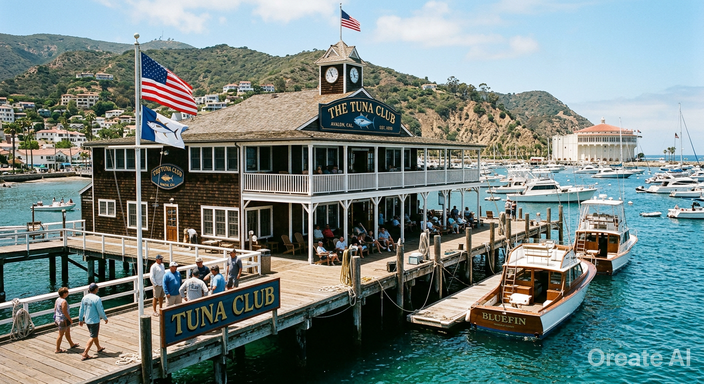
Perched on the edge of the crystal-blue waters of Avalon Harbor on Santa Catalina Island stands a modest, white-shingled Victorian building. To the casual tourist, it might appear to be just another charming historical landmark. However, for the global angling community, this structure is a cathedral. The Tuna Club of Avalon is not merely a social organization; it is the birthplace of modern sportfishing, a sanctuary of conservation, and a testament to the pursuit of “fair play” between man and sea.
The Genesis of Ethical Angling
Founded in 1898 by Dr. Charles Frederick Holder, the Tuna Club of Avalon was established during an era when sea fishing was often an exercise in brute force. Before the club’s inception, heavy handlines and industrial-strength equipment were the norms. Dr. Holder, a naturalist and passionate fisherman, sought to transform the act of catching large pelagic fish into a sophisticated sport that required skill, patience, and specialized tackle.
The catalyst for the club’s founding was Holder’s legendary catch of a 183-pound bluefin tuna using a light rod and reel—a feat many at the time thought impossible. This achievement proved that technical finesse could triumph over raw power. The club was subsequently formed to promote the use of light tackle and to establish a rigid code of ethics that prioritized the challenge of the catch over the quantity of the kill.
The Rule of Fair Play
At the heart of the Tuna Club’s philosophy is the concept of “fair play.” The club’s founding members believed that for a catch to be honorable, the fish must be given a sporting chance. This led to the creation of the first standardized rules for ocean angling, many of which served as the blueprint for the International Game Fish Association (IGFA) decades later.
The club strictly mandated the use of linen lines and specific rod weights. Perhaps most notably, the rules stipulated that the angler must hook, fight, and bring the fish to gaff entirely unassisted. If any other person touched the rod, reel, or line during the struggle, the catch was disqualified from the club’s prestigious record books. These standards forced fishermen to develop an intimate understanding of their equipment and the behavior of their prey, elevating fishing from a harvest to an art form.
A Sanctuary of History and Tradition
The clubhouse itself, completed in 1916 after a fire destroyed the original structure, is a living museum. It was added to the National Register of Historic Places in 1991, and for good reason. Its walls are adorned with vintage photographs, antique wooden rods, and massive taxidermy mounts of record-breaking tuna, swordfish, and marlin.
Inside, the atmosphere is one of quiet reverence. The club has maintained its exclusivity and traditional decor for over a century. Walking through its halls is akin to stepping back into the Golden Age of California’s coastal development. The “Trophy Room” serves as a chronological archive of the evolution of fishing technology, showcasing the transition from rudimentary wooden reels to the sophisticated gear that began to emerge in the mid-20th century.
Illustrious Membership: From Presidents to Poets
The Tuna Club has always been a magnet for the influential and the adventurous. Its membership roster reads like a “Who’s Who” of American history. General George S. Patton, an avid sailor and fisherman, was a member, as was British Prime Minister Winston Churchill, who famously caught an 188-pound marlin off the coast of Catalina in 1929.
Literary giant Zane Grey, famous for his Western novels and his obsession with big-game fishing, was also a prominent, albeit sometimes controversial, figure within the club. Grey’s competitive spirit and his quest for world records often put him at odds with the club’s leadership, but his contributions to the lore of Catalina fishing remain unparalleled. The presence of such figures helped solidify the club’s reputation as the most prestigious angling society in the world.
The Evolution Toward Conservation
While the early years of the Tuna Club were focused on the glory of the catch, the organization evolved into a powerful voice for marine conservation. As early as the 1920s, members began to notice a decline in the local tuna populations due to commercial overfishing.
The club was instrumental in lobbying for the protection of California’s coastal waters. They recognized early on that without sustainable practices, the sport they loved would vanish. Today, the Tuna Club continues this legacy by supporting marine research and promoting “catch and release” for many species. The transition from “harvesters” to “stewards” of the ocean is perhaps the club’s most significant contribution to the modern era.
The Annual Rituals and the “Buttons”
One of the most enduring traditions of the Tuna Club is the awarding of “buttons.” Members earn these based on the size of the fish they catch and the weight of the line used. A “Blue Button” for a tuna caught on heavy tackle is respected, but the “Gold Button” remains the pinnacle of achievement, signifying a major catch on incredibly light line.
These awards are not just about ego; they represent a mastery of the craft. To land a broadbill swordfish—often called the “gladiator of the sea”—under Tuna Club rules is considered one of the most difficult feats in all of sports. The club’s insistence on these high standards ensures that the heritage of Dr. Holder’s original vision remains intact.
Why Avalon?
The location of the club in Avalon is no coincidence. The waters surrounding Santa Catalina Island are unique due to the intersection of warm and cold currents, creating a nutrient-rich environment that attracts a diverse array of game fish. The deep submarine canyons just offshore provide the perfect habitat for the elusive broadbill swordfish and the powerful bluefin tuna.
Avalon provided a sheltered harbor where the elite of Los Angeles and beyond could moor their yachts and gather to share stories of the “one that got away.” The geography of the island itself, with its rugged cliffs and clear Mediterranean-like waters, added an element of romance to the pursuit of big-game fish.
The Enduring Influence
As the Tuna Club of Avalon moves further into its second century, its influence remains profound. Every time an angler chooses to use lighter tackle to give a fish a fair chance, or every time a “catch and release” policy is implemented to preserve a species, the spirit of the Tuna Club is present.
The organization serves as a reminder that sport is at its best when it is governed by honor and respect for nature. In an age of rapidly changing technology and commercialization, the Tuna Club stands as a beacon of tradition—a white-shingled sentinel guarding the history, the ethics, and the soul of the sea.
For those who visit Avalon, a glance at the Tuna Club is a glance at the very foundation of salt-water angling. It is a monument to the idea that the true value of fishing lies not in the weight of the haul, but in the integrity of the struggle.
