

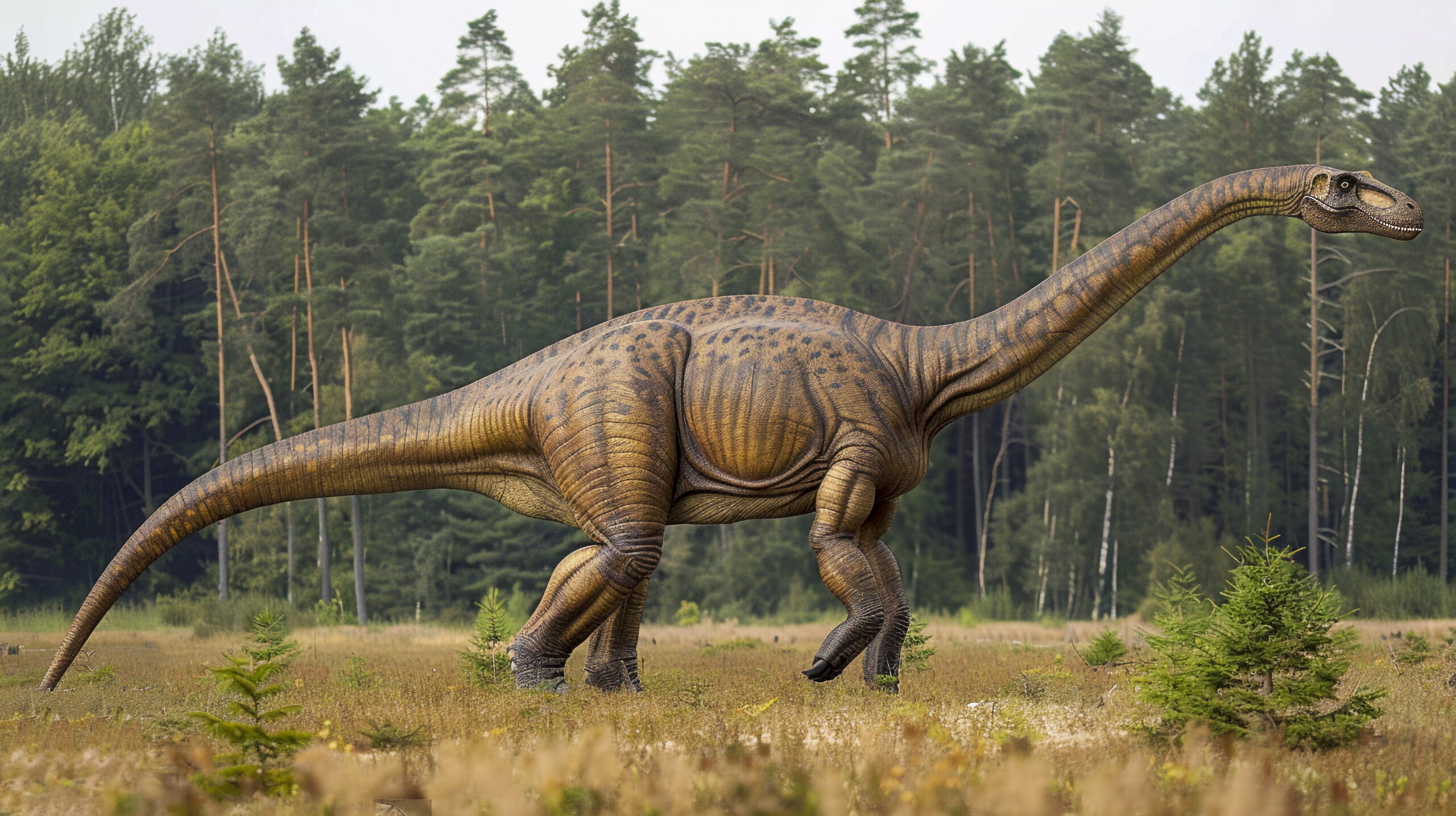
1. Edmontosaurus: An Introduction
Edmontosaurus, meaning “lizard from Edmonton,” was a large, plant-eating dinosaur that roamed western North America during the final days of the dinosaur era. As a member of the hadrosaurid family, it is famously known as a “duck-billed” dinosaur due to its broad, flat snout. The first fossils were discovered in Alberta, Canada, and it was formally named by paleontologist Lawrence Lambe in 1917. Edmontosaurus lived during the Late Cretaceous Period, approximately 73 to 66 million years ago, making it one of the last non-avian dinosaurs to exist before the mass extinction event. Its abundance in the fossil record and the exceptional preservation of some specimens have made it incredibly important for paleontology, offering a detailed window into the biology and environment of the Late Cretaceous.
2. Physical Characteristics of Edmontosaurus
Edmontosaurus was one of the largest hadrosaurs, reaching impressive lengths of up to 13 meters (43 feet) and weighing around 4-5 metric tons. It had a bulky body, powerful hind legs, and shorter forelimbs, allowing it to move on both two legs (bipedally) and four (quadrupedally). A long, heavy tail provided counterbalance while walking or running. One of its most distinctive features was its head, which featured a wide, toothless beak ideal for cropping plants. Unlike some of its relatives, Edmontosaurus lacked a bony crest on its skull, but recent fossil evidence suggests that at least one species, Edmontosaurus regalis, possessed a soft-tissue comb on its head, similar to a rooster’s comb. Remarkable “mummy” fossils have shown that its body was covered in non-overlapping, pebble-like scales of various sizes.
3. Diet and Feeding Habits of Edmontosaurus
As a dedicated herbivore, Edmontosaurus had a highly specialized feeding system. Fossilized gut contents show that it consumed a variety of tough plant material, including conifer needles, twigs, seeds, and other terrestrial plants. Its broad, duck-like beak was toothless and perfect for clipping and gathering vegetation. The real work of chewing happened further back in its jaws. Here, Edmontosaurus possessed complex “dental batteries”—hundreds of teeth packed tightly into columns. As teeth wore down from grinding tough plants, new ones would erupt to replace them. This incredibly efficient chewing mechanism allowed it to process large quantities of food to sustain its massive body. It was likely a low-level browser, feeding on plants up to 4 meters high.
4. Habitat and Environment
Edmontosaurus lived in the lush coastal plains and river deltas along the western edge of the Western Interior Seaway—an ancient sea that once split North America in two. Its fossils are found in a wide geographic range, from Alaska in the north to Colorado and Wyoming in the south. The climate of the Late Cretaceous was warmer and more humid than today, supporting dense forests of conifers, ferns, and newly evolved flowering plants. This rich ecosystem was home to a diverse community of dinosaurs, including the horned Triceratops, the armored Ankylosaurus, and its primary predator, the mighty Tyrannosaurus rex.
5. Behavior and Social Life
Evidence from large “bonebeds”—fossil sites containing the remains of hundreds of Edmontosaurus individuals of all ages—strongly suggests that these animals were highly social and lived in large herds. Living in a group would have offered protection, especially for young and vulnerable members. While we cannot know for sure how they communicated, it is likely they used a combination of vocalizations (bellows or honks) and visual signals. The recently discovered fleshy head comb may have been used for display, helping individuals recognize members of their own species or attract mates. Their herding behavior may have also been linked to seasonal migration in search of food and safer breeding grounds.
6. Edmontosaurus vs Other Hadrosaurs
The hadrosaur family was diverse, and Edmontosaurus is a prime example of the saurolophine (“flat-headed”) branch. This contrasts with the lambeosaurine hadrosaurs, like Parasaurolophus, which are famous for their large, hollow, bony head crests. The primary difference is this headgear: the crest of Parasaurolophus was likely used to produce deep, resonant sounds for communication, whereas Edmontosaurus lacked this structure. Despite this difference, they shared many similarities: a duck-billed snout, complex dental batteries, and a social, herding lifestyle. These variations in head anatomy show the different evolutionary paths hadrosaurs took to adapt for communication and species recognition within their shared environments.
7. Fossil Discoveries and Sites
Some of the most spectacular dinosaur fossils ever found belong to Edmontosaurus. Major fossil sites include the Hell Creek Formation in Montana and the Dakotas, the Lance Formation in Wyoming, and the Horseshoe Canyon Formation in Alberta, Canada. The most famous specimens are the “mummies,” such as “Dakota” and “Leonardo,” which were preserved so exceptionally that they retain fossilized skin, muscle tissue, tendons, and even the contents of their last meal. These incredible fossils provide unparalleled information about the animal’s biology, from its skin texture and musculature to its diet and internal anatomy, making Edmontosaurus one of the best-understood dinosaurs.
8. Predators and Threats
Living in the Late Cretaceous meant facing constant danger from formidable predators. The primary threat to Edmontosaurus was Tyrannosaurus rex, the apex predator of its ecosystem. Fossil evidence confirms this relationship, as some Edmontosaurus bones have been found with T. rex bite marks. Some specimens even show healed bite marks, indicating that these herbivores sometimes survived an attack. The main defense for Edmontosaurus was its size, speed, and social behavior. By staying within a large, alert herd, an individual’s chances of survival increased. If threatened, it could likely run at considerable speed on its powerful hind legs to escape.
9. Extinction of Edmontosaurus
Edmontosaurus was one of the last non-avian dinosaurs on Earth. Its fossils are found in rocks dating right up to the end of the Cretaceous Period, 66 million years ago. Its extinction, along with that of T. rex, Triceratops, and 75% of all species on the planet, was caused by the End-Cretaceous extinction event. The leading cause is the impact of a massive asteroid in the Yucatán Peninsula, Mexico. This cataclysmic event triggered global wildfires, massive tsunamis, and threw so much dust and debris into the atmosphere that it blocked out the sun for months or years. This “impact winter” caused a collapse of plant life, which in turn led to the starvation and extinction of large herbivores like Edmontosaurus and the carnivores that depended on them.
10. Edmontosaurus in Popular Culture and Science
Today, Edmontosaurus is a star attraction in natural history museums around the world, with its large skeletons giving visitors a true sense of the scale of these magnificent creatures. While it may not be as famous as T. rex in movies, it is a staple in dinosaur documentaries and books, often representing the classic “duck-billed dinosaur.” In the scientific community, Edmontosaurus is of immense importance. Due to the wealth of fossil material, it serves as a “model organism” for understanding hadrosaur biology, behavior, and evolution. Ongoing research continues to uncover new secrets, and the study of its exceptionally preserved remains promises to teach us even more about the lost world of the dinosaurs.
