

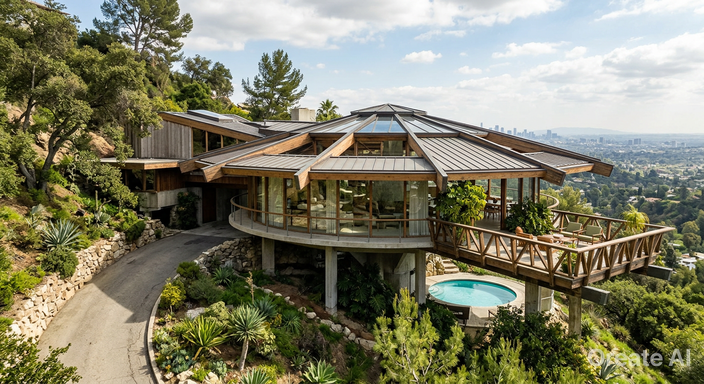
Perched precariously yet purposefully above the shimmering sprawl of Los Angeles, the Foster-Carling Residence stands as a definitive testament to the radical vision of John Lautner. Completed in 1947 for Kenneth Foster and James Carling, this residence is not merely a house; it is a structural manifesto that challenged the domestic conventions of the post-war era. As a protégé of Frank Lloyd Wright, Lautner inherited a deep respect for organic architecture, but at the Foster-Carling site, he transcended his mentor’s teachings to create something entirely futuristic, kinetic, and profoundly connected to the topography of the Hollywood Hills.
The Genesis of a Radical Form
By the late 1940s, Southern California was a laboratory for experimental living. While the Case Study House program was gaining momentum, John Lautner was carving out a singular niche characterized by daring engineering and a rejection of the “box” as a living space. The Foster-Carling Residence was one of his earliest opportunities to flex this creative muscle.
The site itself—a steep, narrow ridge overlooking the San Fernando Valley—demanded an unconventional approach. Lautner’s solution was to utilize a steel-supported structure that allowed the house to hover over the hillside, minimizing its footprint while maximizing its exposure to the horizon. The design utilized a hexagonal module, a geometric preference that would recur throughout Lautner’s career, allowing for fluid transitions between rooms and an inherent sense of movement.
The Revolutionary Swinging Wall
Perhaps the most famous feature of the Foster-Carling Residence—and a hallmark of Lautner’s “kinetic” architecture—is the ingenious living room wall. In an era before massive sliding glass doors were commonplace, Lautner devised a way to literally erase the boundary between the interior and the landscape.
A massive section of the glass-and-redwood wall, supported by a central steel mast, was designed to swing outward on a track. With the push of a button, the living room transformed into an outdoor pavilion. This was not merely a gimmick; it was a functional extension of the home’s philosophy. When the wall opened, the sofa (which was built into the structure) became an outdoor lounge, and the fireplace, once the heart of the indoor hearth, became an open-air pit. This seamless integration of mechanical engineering and domestic comfort predated the high-tech movements of later decades by nearly thirty years.
Materiality and Craftsmanship
The Foster-Carling Residence is a masterclass in the use of “honest” materials. Lautner utilized a palette of redwood, concrete, steel, and glass to create a tactile environment that felt both grounded and ethereal. The redwood ceilings are slatted, drawing the eye toward the views and providing a rhythmic warmth to the space. The masonry work, particularly the massive stone fireplace, provides a sense of permanence and weight against the lightness of the glass walls.
Unlike the sterile minimalism of many European modernists, Lautner’s work at Foster-Carling was deeply textured. He understood that light was a primary building material. By manipulating the rooflines and clerestory windows, he ensured that the quality of light shifted throughout the day, painting the interior with changing shadows and highlights that reflected the movement of the sun across the canyon.
Engineering the Impossible: The Floating Roof
The structural integrity of the home is anchored by a three-legged steel frame, which supports the roof and allows for the vast expanses of glass. This engineering feat meant that internal load-bearing walls were largely unnecessary. The result is a floor plan that feels significantly larger than its actual square footage.
The roof itself appears to float above the glass, an effect that Lautner would later perfect in his more famous projects like the Chemosphere or the Sheats-Goldstein Residence. At Foster-Carling, we see the early iterations of his fascination with “freeing” the roof from the walls. This creates a psychological sense of shelter without confinement, a balance that is difficult to achieve but essential to the Los Angeles lifestyle.
The Pool as a Visual Horizon
In many of Lautner’s designs, water plays a central role. At the Foster-Carling Residence, the swimming pool is positioned to act as a visual bridge between the man-made structure and the natural sky. The pool’s edge aligns with the horizon line of the San Fernando Valley, creating a precursor to the “infinity edge” pools that are now ubiquitous in luxury architecture. By placing the pool so close to the living area, Lautner ensured that the reflection of water and the play of light off the surface would be constant companions to the inhabitants.
Legacy and Preservation
The Foster-Carling Residence remains one of the most significant pieces of mid-century modern architecture in the world. It serves as a bridge between the organic traditions of the early 20th century and the high-tech, space-age explorations of the late 20th century. For years, the home was meticulously maintained, and in the late 1990s, it underwent a sensitive restoration that ensured its mechanical systems—including the iconic swinging wall—remained functional.
Architects and historians often point to this residence as the moment John Lautner fully stepped out of the shadow of Frank Lloyd Wright. While Wright’s influence is visible in the stonework and the integration with nature, the daring use of steel and the mechanical audacity of the swinging wall were purely Lautner. He demonstrated that a house could be a machine for living that did not sacrifice soul or beauty for the sake of efficiency.
Conclusion: A Vision Realised
To stand inside the Foster-Carling Residence is to experience a specific type of California optimism. It represents a time when the future felt limitless, and the rugged terrain of Los Angeles was seen as a canvas for radical New World thinking. Lautner did not just build a house for Foster and Carling; he built a viewing platform for the evolution of the city.
The house continues to inspire contemporary architects who seek to balance the demands of modern technology with the timeless need for a connection to the natural world. It remains a reminder that architecture, at its best, is not just about shelter—it is about expanding the human experience through space, light, and movement. The Foster-Carling Residence is not a relic of the past; it is a living, breathing entity that continues to define the pinnacle of hillside modernism.
