

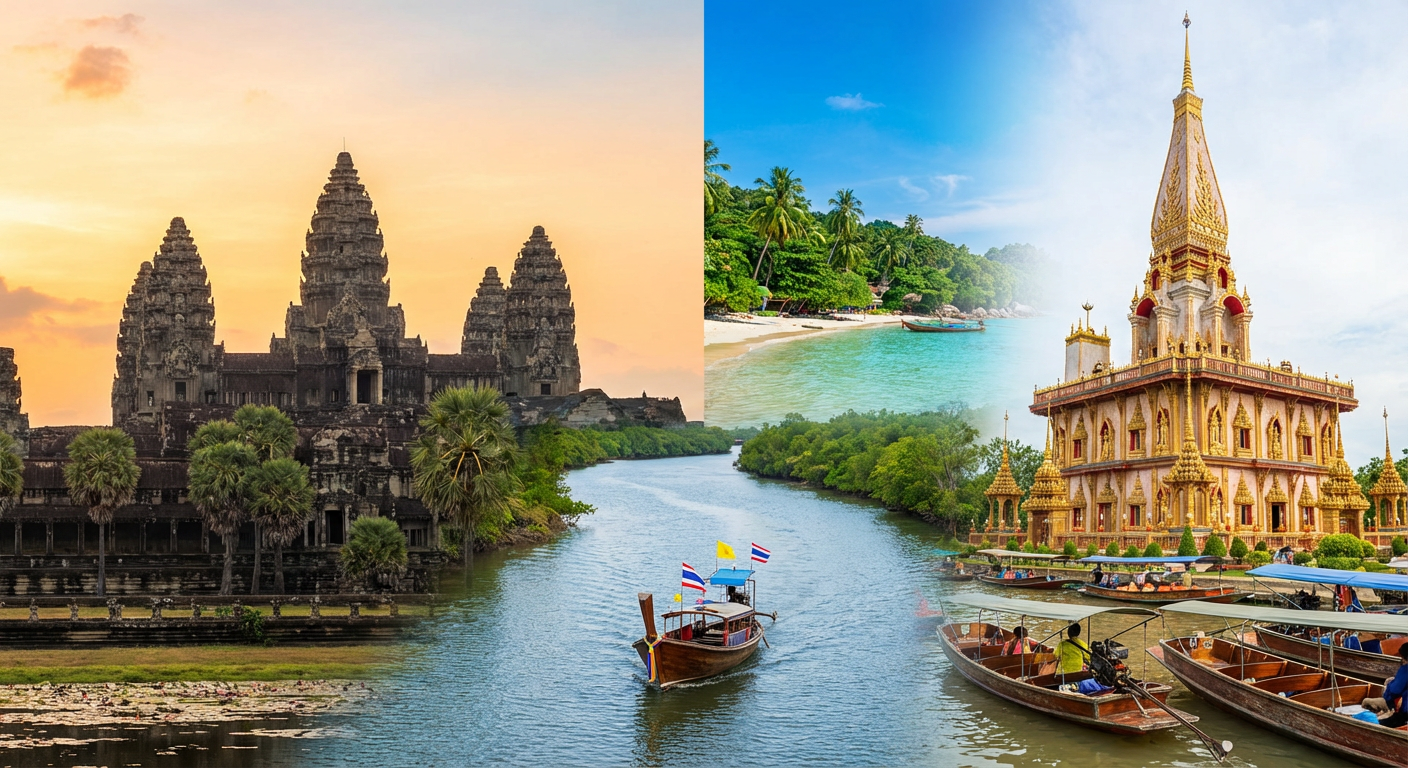
The relationship between Cambodia and Thailand is one of the most complex, vibrant, and enduring dynamics in Southeast Asia. Sharing a border that stretches over 800 kilometers, these two nations are bound by a shared religion, similar linguistic roots, and a history that has seen both empires clash and cultures intertwine. For the modern traveler or historian, understanding the nuances between Cambodia and Thailand offers a gateway into the soul of the Indochinese Peninsula.
The Historical Tapestry: Angkor and Ayutthaya
To understand Cambodia and Thailand today, one must look back at the Khmer Empire and the rise of the Siamese kingdoms. At its peak, the Khmer Empire, centered at Angkor, ruled over vast swaths of modern-day Thailand. This is why travelers will find stunning Khmer-style ruins in Thai provinces like Buriram and Phimai.
As the power of Angkor waned, the Thai kingdoms of Sukhothai and later Ayutthaya rose to prominence, eventually asserting dominance over the region. This historical “tug-of-war” resulted in a massive cultural exchange. Elements of Khmer court ritual, architecture, and writing were adopted by the Thais, while later centuries saw Thai influence permeate Cambodian music, dance, and dress. Today, while both nations are fiercely proud of their unique identities, the echoes of this shared past are visible everywhere—from the curved gables of their Buddhist temples to the rhythmic movements of their classical dance.
Cultural Parallels: Theravada Buddhism and Daily Life
The most significant common denominator between Cambodia and Thailand is Theravada Buddhism. It is the bedrock of social morality, daily routine, and national holidays in both countries. In both Phnom Penh and Bangkok, the day begins with the sight of saffron-robed monks collecting alms.
The concept of “merit-making” governs social behavior, and the “Wai” (Thailand) or “Sampeah” (Cambodia)—the act of placing palms together in a prayer-like gesture—is the universal sign of respect. Even the festivals follow the same lunar calendar. The solar New Year, known as Songkran in Thailand and Chol Chnam Thmey in Cambodia, occurs in April and involves water-splashing rituals to wash away the misfortunes of the previous year.
Economic Synergy and Modern Infrastructure
In the 21st century, the relationship has shifted from historical rivalry to economic interdependence. Thailand serves as a major regional hub and a primary source of foreign direct investment for Cambodia. Conversely, Cambodia provides a vital labor force for Thai industries and a growing market for Thai manufactured goods.
Cross-border trade is centered around key economic zones like Aranyaprathet-Poipet and Koh Kong. These gateways are not just for goods; they are the arteries of the regional tourism industry. The “Two Kingdoms, One Destination” initiative has sought to encourage travelers to visit both the beaches of Thailand and the temples of Cambodia in a single trip, facilitated by improved road networks and increasing flight connections between Bangkok, Siem Reap, and Phnom Penh.
Culinary Landscapes: A Tale of Spice and Herb
While the world is intimately familiar with Thai cuisine—famed for its bold use of chili, lemongrass, and galangal—Cambodian (Khmer) cuisine is a hidden gem that shares many ingredients but offers a different flavor profile.
Thai food often hits four notes simultaneously: spicy, sour, sweet, and salty. Cambodian food, while sharing the love for fermented fish paste (Prahok) and coconut milk, tends to be more subtle and herb-forward, with a lower heat level. For example, the Thai Red Curry and the Cambodian Amok may look similar, but the Amok is a delicate, steamed coconut mousse that emphasizes fragrance over fire. Exploring the culinary transition across the border is a highlight for any food enthusiast.
Crossing the Border: Practical Tips for Travelers
For many international tourists, the journey between Cambodia and Thailand is a rite of passage. There are several ways to make the transit:
- By Air: The most convenient method. Multiple daily flights connect Bangkok (BKK and DMK) to Phnom Penh and Siem Reap. This is the fastest way to bypass the sometimes-chaotic land borders.
- By Land (The Poipet Crossing): This is the most popular land route, connecting Bangkok to Siem Reap. While it has a reputation for being hectic, it is the most direct way to reach Angkor Wat from Thailand by road.
- By Land (The Coastal Route): Crossing from Trat in Thailand to Koh Kong in Cambodia is ideal for those looking to explore the pristine beaches and islands of the Gulf of Thailand.
Visa Requirements: Most Western travelers require a visa for Cambodia (available as an e-visa or on arrival), while Thailand offers visa-exempt entry for many nationalities. Always check the latest regulations before arriving at the border.
Environmental and Maritime Cooperation
Beyond tourism and trade, Cambodia and Thailand share a critical interest in the Gulf of Thailand and the Mekong River basin. Environmental cooperation is becoming increasingly important as both nations face the challenges of climate change and water management. Issues such as overfishing and plastic pollution in the Gulf require a unified front. In recent years, bilateral talks have increasingly focused on “blue economy” initiatives, aiming to protect the marine biodiversity that supports the tourism and fishing industries of both nations.
The Future of the Two Kingdoms
As members of ASEAN, Cambodia and Thailand are working toward greater regional integration. While political sensitivities regarding the border occasionally surface—most notably the dispute over the Preah Vihear Temple in years past—the general trajectory is one of cooperation.
Digital nomads and expatriates are increasingly viewing the two countries as a single “living zone.” It is common to find people who live in the cosmopolitan sprawl of Bangkok but spend their weekends exploring the colonial charm of Battambang or the quiet riverside of Kampot.
Conclusion
Cambodia and Thailand are more than just neighbors; they are cultural cousins with a shared destiny. Whether you are marveling at the golden spires of the Grand Palace in Bangkok or watching the sunrise over the five towers of Angkor Wat, you are experiencing the results of over a millennium of shared history. By understanding the deep-rooted connections between these two nations, travelers can move beyond the surface-level attractions and truly appreciate the rich, layered heritage of Southeast Asia.
The synergy between the “Land of Smiles” and the “Kingdom of Wonder” continues to evolve, promising a future where the borders become bridges for culture, commerce, and mutual prosperity.
